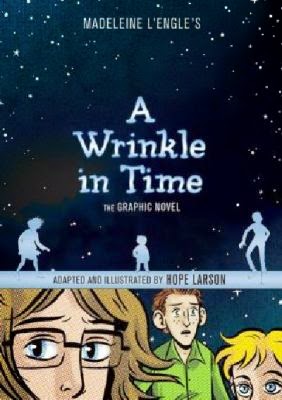
Larson, H., Engle, M., & Farrar, S. (2012). A wrinkle in time: The graphic novel. New York: Farrar, Straus & Giroux.
Great Graphic Novels for Teens 2013
Through the use of blue, black and white illustrations, author Hope Larson retells Madeleine L'Engle's famous story A Wrinkle in Time. This is the story of Meg Murry and her own coming of age journey. She and her family do not fit in and her father has been missing for several years. She and her brother along with an acquaintance, Calvin O'Keefe, are sent on a fantastical journey through space to save her father and fight the darkness. Through this journey, Meg discovers more about herself and her family and finds strength she didn't know she had.
I don't know that I have ever actually read A Wrinkle in Time, although I am familiar with the characters of Mrs. Whatsit, Mrs. Who, and Mrs. Which. I loved the telling of this story through a graphic novel. This is a great way to allow students to read a classic story in a modern way.
Saturday, March 21, 2015
Navigating Early
Vanderpool, Clare. Navigating Early. New York: Delacorte, 2013. Print.
Printz Honor 2014
Navigating Early is about the right of passage journeys for two boys, Jack Baker and Early Auden. Jack has just lost his mother and his father who has been away at war for the last several years has uprooted him from his life in Kansas to a boarding school in Maine. There, Jack befriends the quirky Early Auden. Early has suffered his own losses, and as a way to find answers takes Jack on a quest to find the Great Appalachian Bear. What stars out as being Early's journey and adventure, becomes a coming of age journey for both boys. Both boys come to terms with their own losses and find an even deeper friendship and strength in each other.
One thing I absolutely loved about this book was that the boys' journey mirrors that of the number pi. I was tempted more than once to start calculating pi. It was such a clever and intriguing idea to think that numbers could tell a story of their own. That seems like it would be a great cross curricular connection to make and a fun extension activity to accompany this book.
Navigating Early is about the right of passage journeys for two boys, Jack Baker and Early Auden. Jack has just lost his mother and his father who has been away at war for the last several years has uprooted him from his life in Kansas to a boarding school in Maine. There, Jack befriends the quirky Early Auden. Early has suffered his own losses, and as a way to find answers takes Jack on a quest to find the Great Appalachian Bear. What stars out as being Early's journey and adventure, becomes a coming of age journey for both boys. Both boys come to terms with their own losses and find an even deeper friendship and strength in each other.
One thing I absolutely loved about this book was that the boys' journey mirrors that of the number pi. I was tempted more than once to start calculating pi. It was such a clever and intriguing idea to think that numbers could tell a story of their own. That seems like it would be a great cross curricular connection to make and a fun extension activity to accompany this book.
Lizzie Bright and the Buckminster Boy
Schmidt, G. (2004). Lizzie Bright and the Buckminster boy. New York: Clarion Books.
Printz Honor 2005
Turner Buckminister III has just moved from Boston to Phippsburg, Maine where his father is going to be the minister at Phippsburg's First Congregational Church. Turner finds the towns' inhabitants to be inhospitable and unwelcoming. He finds solace in Lizzie Bright, a resident of the island of Malaga which is home to former slaves and their descendants. The towns people of Phippsburg see the inhabitants of Malaga to be a blemish on their town and they order them to leave. The elders of the town get Turner's father to stand with them, leaving Turner to defend Lizzie and her people alone.
This book would be good for middle school age kids. It's themes of injustice and tolerance interwoven with religion along with the historical elements of the story will pull kids in and give them food for thought.
Printz Honor 2005
Turner Buckminister III has just moved from Boston to Phippsburg, Maine where his father is going to be the minister at Phippsburg's First Congregational Church. Turner finds the towns' inhabitants to be inhospitable and unwelcoming. He finds solace in Lizzie Bright, a resident of the island of Malaga which is home to former slaves and their descendants. The towns people of Phippsburg see the inhabitants of Malaga to be a blemish on their town and they order them to leave. The elders of the town get Turner's father to stand with them, leaving Turner to defend Lizzie and her people alone.
This book would be good for middle school age kids. It's themes of injustice and tolerance interwoven with religion along with the historical elements of the story will pull kids in and give them food for thought.
Code Name Verity
Wein, E. (2012). Code Name Verity. NY: Egmont.
This story is about two teenage girls, Julie and Maddie, during World War II. The first half of the story is told by Julie who has been captured and imprisoned by the Nazi's. The second half of the story is told by Maddie, who Julie believed to be dead. Maddie joins the resistance group Damask. Damask sets up an ambush to rescue Julie, but the ambush goes awry, so Maddie ends up shooting Julie so that she will not be at the hands of the Nazi's.
This is another great work of historical fiction. The plot is unique in that it is about girls fighting in World War II, rather than men. I think that aspect alone would draw female readers to this book. The girls' personalities and the plot are deeply developed through the use of their thoughts, their actions, their memories and their writing.
This story is about two teenage girls, Julie and Maddie, during World War II. The first half of the story is told by Julie who has been captured and imprisoned by the Nazi's. The second half of the story is told by Maddie, who Julie believed to be dead. Maddie joins the resistance group Damask. Damask sets up an ambush to rescue Julie, but the ambush goes awry, so Maddie ends up shooting Julie so that she will not be at the hands of the Nazi's.
This is another great work of historical fiction. The plot is unique in that it is about girls fighting in World War II, rather than men. I think that aspect alone would draw female readers to this book. The girls' personalities and the plot are deeply developed through the use of their thoughts, their actions, their memories and their writing.
The Knife of Never Letting Go
Ness, P. (2008). The Knife of Never Letting Go. Boston, MA: Candlewick Press.
Patrick Ness' The Knife of Never Letting Go, is a coming of age story about Todd Hewitt set in a dystopian world. In this world, we learn about the existence of "noise". Noise is others' (including animals') thoughts. Out in the swamps, Todd finds a patch of quiet, which turns out to be the other main character, Viola. Together, she and Todd are being tracked by the people from Todd's town. Together, the two have many narrow escapes, but ends with surrender so Viola can receive care. Those that have been tracking them, have taken over Todd and Viola's last hope, Haven.
Teens will love this dystopian story. The unique setting is integral to the story. The characters' development is unique as well, since Todd's thoughts can be read and he can read other men's thoughts, but Viola's thoughts can't be read. This causes an interesting relationship between the two of them. The abrupt ending is both frustrating (it seems like a lot of the books I have read have abrupt endings), but enticing to read the next book in the series.
Patrick Ness' The Knife of Never Letting Go, is a coming of age story about Todd Hewitt set in a dystopian world. In this world, we learn about the existence of "noise". Noise is others' (including animals') thoughts. Out in the swamps, Todd finds a patch of quiet, which turns out to be the other main character, Viola. Together, she and Todd are being tracked by the people from Todd's town. Together, the two have many narrow escapes, but ends with surrender so Viola can receive care. Those that have been tracking them, have taken over Todd and Viola's last hope, Haven.
Teens will love this dystopian story. The unique setting is integral to the story. The characters' development is unique as well, since Todd's thoughts can be read and he can read other men's thoughts, but Viola's thoughts can't be read. This causes an interesting relationship between the two of them. The abrupt ending is both frustrating (it seems like a lot of the books I have read have abrupt endings), but enticing to read the next book in the series.
Leviathan
Westerfield, S. (2009). Leviathan. NY: Simon Pulse.
Leviathan is a twisted version of World War I, where we have real events and people mixed into a fictitious, futuristic world. The story follows two teens, Deryn Sharp and Prince Aleksander of Hohenburg. Instead of the Central Powers and the Allies (yes, I had to look that up), we have Clankers and the Darwinists. The story follows each teen seperately, then brings them together. Leviathan ends abruptly, making it necessary to continue the series if the reader wants to find out what has happened.
I love when authors write stories, especially science fiction, that mirror times in history. Unfortunately for me, I am not a World War I buff, so there were many things I had to look up to see if they related to something or someone real. But what a great learning opportunity that would present for teachers and students. This would be a great book to use with sophomores (typically the year they take world history) so that the two classes could feed off of each other.
Leviathan is a twisted version of World War I, where we have real events and people mixed into a fictitious, futuristic world. The story follows two teens, Deryn Sharp and Prince Aleksander of Hohenburg. Instead of the Central Powers and the Allies (yes, I had to look that up), we have Clankers and the Darwinists. The story follows each teen seperately, then brings them together. Leviathan ends abruptly, making it necessary to continue the series if the reader wants to find out what has happened.
I love when authors write stories, especially science fiction, that mirror times in history. Unfortunately for me, I am not a World War I buff, so there were many things I had to look up to see if they related to something or someone real. But what a great learning opportunity that would present for teachers and students. This would be a great book to use with sophomores (typically the year they take world history) so that the two classes could feed off of each other.
Looking for Alaska
Green, J. (2005). Looking for Alaska. NY: Dutton.
This story is set around a misfit group of teens at a boarding school in Alabama. Miles Halter has never belonged or had a group of friends before coming to Culver Creek. Here he has found friends and a sense of belonging. He has found a best friend in his roommate, the Colonel, and an infatuation with Alaska. Midway through the story, Alaska tragically and suddenly dies, leaving Miles and the Colonel (along with the other students) to grapple with and accept who she was and her death.
I loved the way John Green wrote this story as a count down and then counting forward marking the kids' recovery. Teens will love this as well. I spent the first half of the book wondering what we were counting down to, and the naive side of me did not ever predict Alaska's death. The themes of love, loss, friendship, and acceptance will resonate and move teen readers- I bet they will make this book into a movie, but like with all books turned to movies, the story won't be told as well.
Subscribe to:
Posts (Atom)


